The postcard version of Beverly Hills in July belongs to visitors. Rodeo at midday, a photo in front of the Beverly Wilshire, a Sprinkles cupcake for the walk back. The version residents live is quieter, later, and mostly on foot. It happens after the tour buses thin out on Wilshire, when the shade finally reaches the west side of Cañon and the patios begin turning over their second seating.
This piece is for the reader who already sleeps in the 90210. You know the freeway exits. You have opinions about which side of Santa Monica Boulevard has the better crosswalks. What follows is a look at how the city actually reads in the middle of summer, and why the most interesting square mile in Los Angeles behaves less like a shopping district and more like a walkable small town once the working day ends.
The two-hour window that changes the city
Between roughly six and eight in the evening, Beverly Hills goes through a quiet handoff. Retail on Rodeo and Beverly begins closing down. The restaurants along Cañon Drive, Beverly Drive, and the side streets off Wilshire start to fill. Sidewalks that felt commercial at four in the afternoon feel residential by seven, because the people on them mostly live within a ten-minute walk.
If you have lived here for any length of time, you already know the corollary. The Golden Triangle is not the after-hours center of gravity. It is the daytime one. The evening center of gravity slides one block east or south, toward the blocks where the awnings extend over the sidewalk and the tables are close enough that you recognize the person next to you.
That geography is the point of this post. Below is how to use it.
Beverly Cañon Gardens, on a Tuesday
Most guides mention Beverly Cañon Gardens as an aside, a green rectangle behind the Montage. That undersells what it does for residents in July. It is the closest thing central Beverly Hills has to a shared living room, and it is programmed all summer.
Bring a coffee from one of the cafés on Cañon in the morning and it functions as an outdoor office with better shade than anything on Wilshire. Bring a book after five and the fountain noise is loud enough to blur out the traffic on Dayton Way. The city runs periodic outdoor performances and screenings in the gardens through the warm months, which means a Tuesday can turn into a plan without ever calling ahead. Look at the current City of Beverly Hills events calendar before you commit to a night in.
A useful test: if you can walk from your front door to a public bench under a jacaranda in under fifteen minutes, you are living in Beverly Hills correctly.
Where the Wallis fits in
The Wallis Annenberg Center for the Performing Arts is the piece of the neighborhood most residents underuse. It sits inside the restored 1933 post office on North Cañon, one block from the library and two from the park. Its summer programming leans toward chamber performances, jazz sets, and family-facing matinees. Tickets often move at a fraction of what an equivalent night in Downtown would cost, and the room is small enough that there are no truly bad seats.
The strategic move for a resident is not to plan a night around a specific show months in advance. It is to look at what is on this week, walk over from dinner, and treat it as the second act of an evening you were going to have anyway. That is a texture of urban life that residents of denser cities take for granted and that most of Los Angeles simply cannot offer.
A short field guide to walking dinners
If you moved here from a driving neighborhood, this may take some retraining. A partial map of dinners you can string together without moving your car:
- South of Wilshire, near Charleville and Reeves. Quieter, more residential in feel, with a handful of long-running neighborhood spots that see the same faces every week.
- Cañon Drive between Brighton and Dayton. The densest patio corridor in the city. Two drinks at one place, entrées at another, dessert at a third is entirely reasonable on foot.
- Beverly Drive north of Santa Monica. More casual, more oriented toward morning and lunch, but a viable option in summer when the light stays late enough to eat outdoors at seven.
- Little Santa Monica between Beverly and Camden. Where several of the newer chef-driven rooms have landed. Worth walking even if you do not have a reservation, on the chance of a bar seat.
The reason this matters for someone who already lives here: it is the single easiest habit shift that will change how the city feels. Two nights a week on foot instead of behind a wheel is the difference between using Beverly Hills as an address and using it as a neighborhood.
Mornings that are still worth setting an alarm for
Summer heat rewrites the daytime schedule. What works at noon in April is unpleasant at noon in July. The move is to reclaim the morning.
Coldwater Canyon Park and Franklin Canyon. Fifteen minutes north from Sunset, these are the closest true trail systems to central Beverly Hills. Franklin Canyon in particular is a Santa Monica Mountains Conservancy property with a small reservoir loop that stays shaded for most of the morning. Go before nine. Come back before ten. The rest of your day will feel earned.
The Beverly Hills Farmers Market on Sunday morning. On Civic Center Drive, between the library and City Hall. It is small enough that you will finish the loop in twenty minutes and see three people you know. Bring a bag. Do not drive.
Roxbury Park early. If you are not up for a canyon hike, the perimeter of Roxbury on the south end of the city is a two-thirds-of-a-mile loop under mature trees. It is the closest thing to a suburban park run inside the city limits, and it empties out by ten.
What the summer light does to the architecture
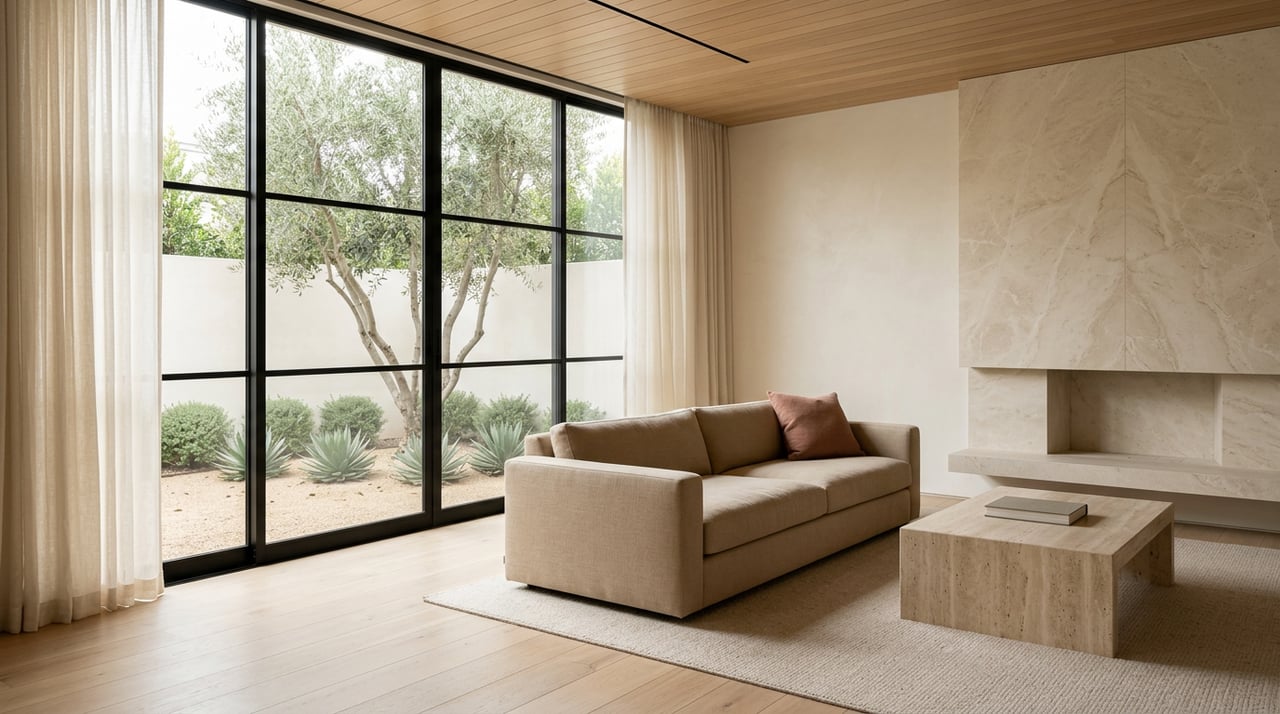
There is one more argument for walking. Beverly Hills has one of the most concentrated collections of significant residential architecture in the country, and summer evenings between seven and eight are the single best hour to see it. The low sun rakes across the limestone and travertine facades on the flats, catches the black steel window frames on the newer contemporary builds north of Sunset, and turns the older Spanish Colonial and Regency homes on Roxbury and Bedford into something closer to a set than a streetscape.
You do not have to be shopping for a house to enjoy this. Most residents drive past these blocks with the windows up and the AC on. Walking them at the right hour is a completely different experience, and it is free.
A minimal Beverly Hills weekend, as a template
| Time | What |
|---|---|
| Saturday, 7:30 a.m. | Franklin Canyon reservoir loop |
| Saturday, 9:30 a.m. | Coffee on Cañon, sit outside |
| Saturday, 6:30 p.m. | Walk to a patio south of Wilshire |
| Saturday, 8:30 p.m. | Whatever is on at the Wallis, or a second stop on Cañon |
| Sunday, 9:00 a.m. | Farmers Market on Civic Center |
| Sunday, 6:00 p.m. | Beverly Cañon Gardens with something cold |
None of this is a discovery. All of it is available to anyone who lives here. The reason to write it down is that most residents run some fraction of it and assume the rest of the neighborhood is Rodeo Drive and traffic on Wilshire. It is not. It is the same small handful of shaded blocks used well.
When the neighborhood eventually becomes a transaction
Living well in Beverly Hills is the first step. Understanding the market that surrounds those blocks is a separate exercise, and one that rewards working with people who have spent decades inside it. When the time comes to think about a move within the city, up the hill, or out toward Bel-Air or the Westside, the team behind The Umansky Team is built for exactly that conversation. Contact Us when you are ready to have it.