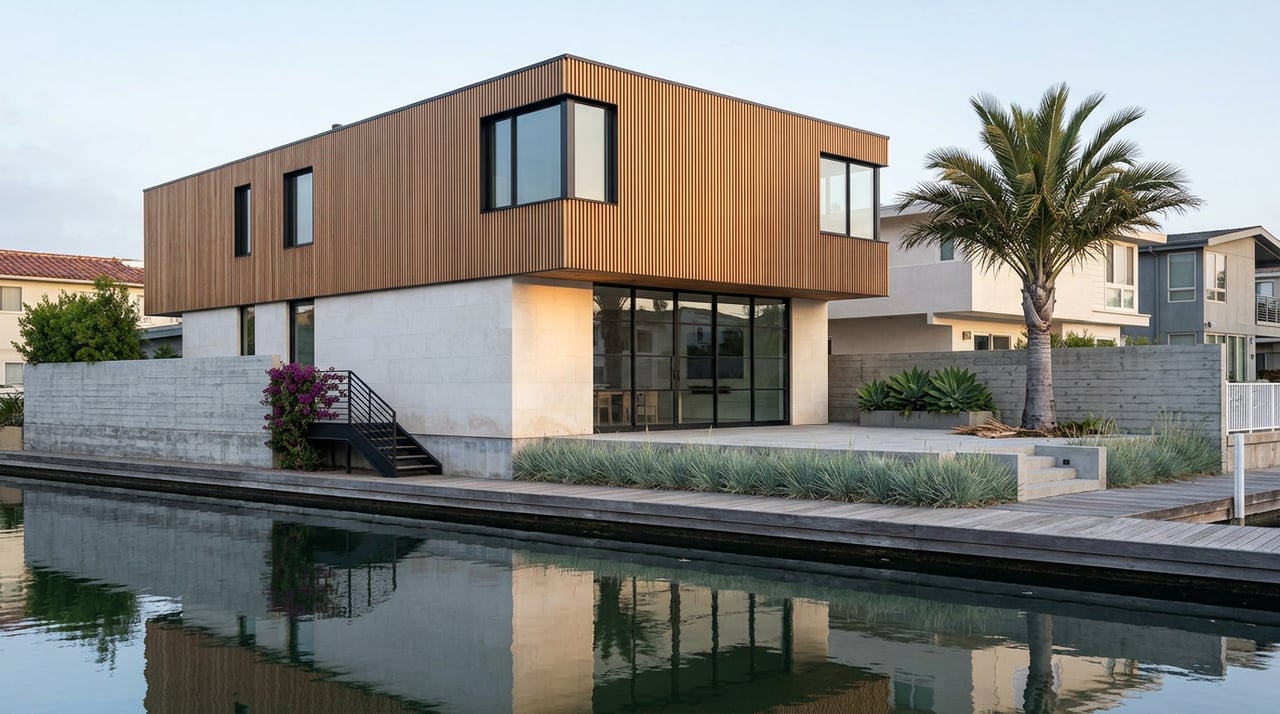
At noon on a Saturday, the Venice Canals can be lively. Strollers pause on the arched footbridges, a tour group gathers at the mouth of Carroll Canal, and dogs and their leashes pass near the Dell Bridge. It is a lovely scene, and a visit at that hour offers one view of the neighborhood.
Come back at seven the next morning and the same six blocks belong to almost no one. A paddleboarder pushes off from a private dock on Howland Canal. A woman in a robe carries coffee out to her patio chair on Linnie. The water sits flat enough to double the sky. This is another part of daily life here: the Venice Canals have a different rhythm at different hours, alongside the boardwalk two blocks away.
The Six Canals, and the Seven That Disappeared
The canals were Abbot Kinney's idea in 1905, built to recreate the feel of Venice, Italy, on a stretch of marshland west of what is now Washington Boulevard. There were originally thirteen of them, Kinney's own seven plus six more dug by a competing developer on the parcel just south. For a couple of decades that gave Venice of America a genuinely improbable street grid, more water than land in places.
It did not last. After Kinney's death and the neighborhood's annexation into the city of Los Angeles, the original seven canals were filled with dirt by the end of 1929 and paved into roads, which is why Main Street and Grand Boulevard still trace the outlines of water that used to be there. What survived is the six-canal core south of Venice Boulevard: Carroll, Linnie, Howland, Sherman, Eastern, and Grand, linked by a network of white pedestrian bridges that most visitors photograph without knowing why they curve the way they do.
That history matters for a practical reason. The canals that remain are not a theme park recreation. They are the leftover half of a much larger system, which is part of why the footprint feels so tightly held. There is no overflow lot, no second entrance, no way to widen the experience. Six canals are what there is, and everyone who lives on or near them has built their week around that scarcity.
Two Clocks, One Walkway
Ask anyone who has actually spent a week in the canal district and the pattern repeats itself with almost no variation: the walkway is a visitor destination from roughly mid-morning through late afternoon, and a residential street again the moment the light starts to go long. Recent visitor accounts of the canal walkway make the same observation almost word for word, one reviewer noting simply that early morning is not crowded, a detail that would be trivial anywhere else and is load-bearing here.
In practice, visitors often walk the footbridges during the day, while some residents paddle or walk dogs in the early morning or evening. The canals can feel busy at one hour and quiet at another.
For residents of the six-canal grid, this is part of the neighborhood's daily rhythm. You learn which hour the light hits the water without a single stranger in frame. You learn that the narrow side streets running perpendicular to the canals, tight enough that a bridge crossing at speed will rattle your teeth, are calmest right around the hours most people plan around, not despite them.
A Calendar of Events at Different Hours
The Venice Canals Association's calendar includes evening events as well as weekend-afternoon activities.
Row-In Movie Nights happen on three Saturday evenings each summer, with a screen set up on the Dell Bridge at Linnie Canal. The invitation is simple: row in, float by, bring a lawn chair.
The Fourth of July also features the Association's regatta and fundraiser at Sherman and Grand Canal. In the weeks leading up to it, rubber duck pre-sales for the race happen at Dell Avenue and Linnie Canal on scheduled weekend afternoons, a small, almost administrative ritual that only makes sense to someone who already knows the race is coming.
As the calendar turns toward fall, the next date on most canal residents' phones is Canalloween, the Association's costume party built for families in the park along the water. It is a kids' event with real turnout, the kind of gathering where neighbors who wave at each other in October actually stop and talk. After that comes the Holiday Boat Parade in December, when residents decorate small boats and float them past their own homes, a tradition the Association describes as a showcase of the neighborhood's distinct character rather than a spectacle for outsiders.
These events are posted on the Association's site. Taken together, they show some of the ways the community gathers at different hours, from weekend afternoons to dusk and evening.
What's Opening for the After
The retail and restaurant activity closest to the canals has started to find a place in the neighborhood's daily rhythm, even if it was not planned that way.
A few blocks north, right under the Venice sign near the boardwalk, a walk-up window called Meadow opened this year serving Greek frozen yogurt in exactly two flavors, the kind of small, single-purpose stop that works precisely because it does not ask you to commit to a sit-down evening. It is a five-minute detour on the way back from a canal walk, not a destination in its own right, which is its whole appeal.
Closer to the water, Venice Beach Club opened as a coastal Italian restaurant and bar within easy walking distance of the boardwalk, Muscle Beach, and the canals themselves, built around an open-air backyard the owners describe as ideal for golden hour cocktails and long, unhurried meals. It is the kind of place that only makes sense in the second half of the day, after the crowds have thinned and the light has gone warm.
And along Pacific Avenue, a new steakhouse opened this spring under chef Sydney Hunter III, built around dry-aged, American-sourced beef, including a 40-ounce porterhouse sourced from Creekstone Farms meant for sharing. It is a dinner destination in the most literal sense, a reservation you make for the hours when the boardwalk has emptied out and the canals two blocks south have already gone quiet for the night.
None of these openings were built specifically for canal residents. But their timing lines up with one part of the neighborhood's daily rhythm, with evening spots offering another option as the day winds down.
Life Beyond the Postcard Views
Guidebooks often highlight the arched bridges, the eclectic mix of architecture, and the ducks. Those are part of the canals' appeal, alongside the quieter residential atmosphere at certain hours. What explains it is timing. The canals draw visitors during the day and offer a quieter residential setting at other hours. Community events include a summer movie night on a floating bridge and a December parade of decorated rowboats.
If you already live here, you know this without needing it explained. If you are weighing a move into this six-canal grid, it is worth seeing it at different times of day.
For questions about property along the canals, in the wider Venice market, or anywhere else on the Westside, The Umansky Team is available to talk through what a specific block, canal, or hour of the day actually looks like day to day. Contact Us.